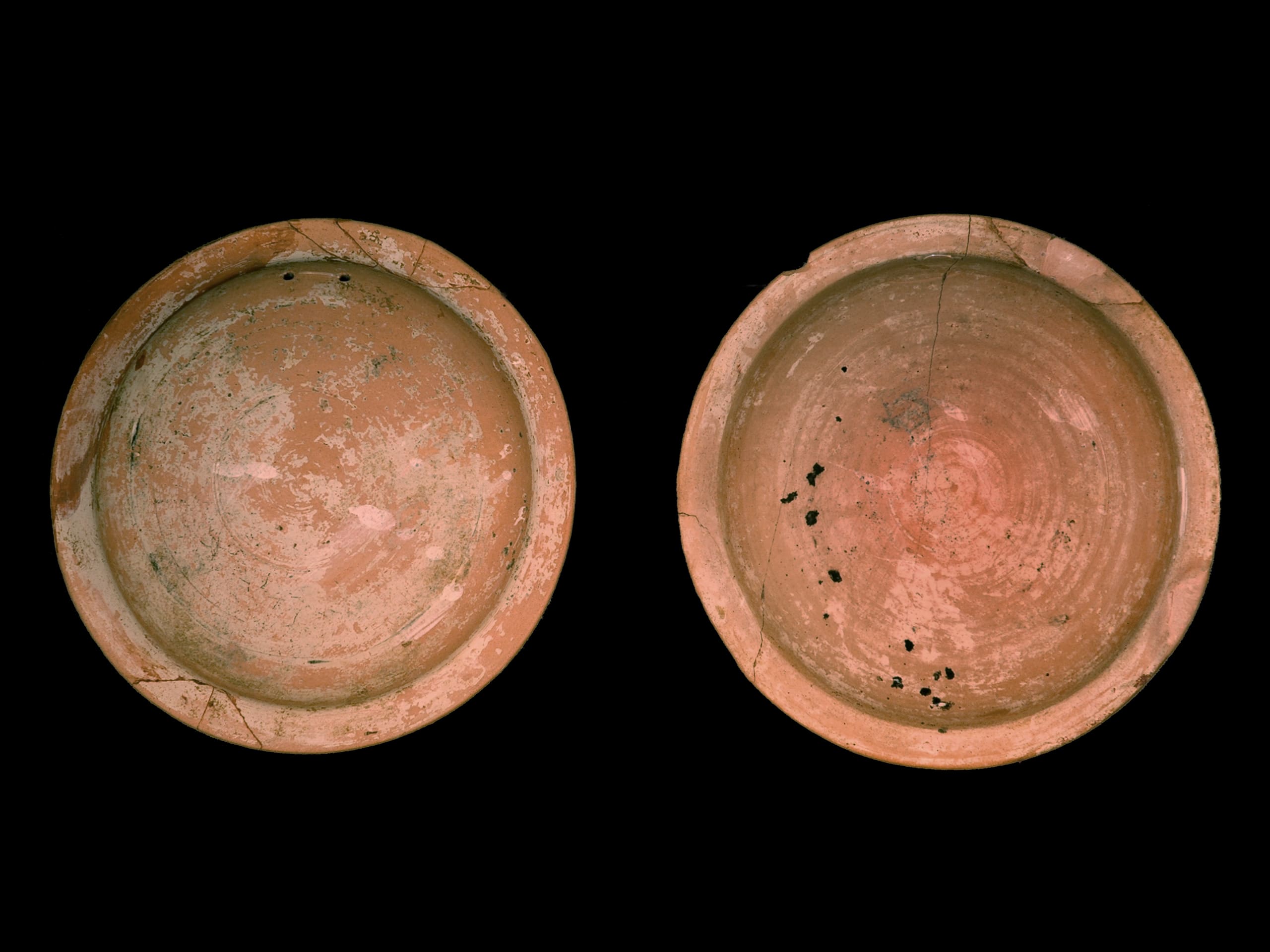



Clay votive shields
Shield models are part of a set of at least ten identical objects. They are 20 cm in diametre, covered with a white coating and have mounting holes.
The victorious troops used to offer the actual shields of their defeated foes to the major Greek sanctuaries or other public places. It is well known that Alexander the Great offered 300 Persian shields as a votive offering to the goddess Athena after the Battle of the Granicus. They were suspended on the southern architrave of the Parthenon, and their mounting holes are visible today. A bronze shield, of those placed by the Athenians in Stoa Poikile after they defeated the Spartans at Pylos, has also been found.
These shields were found in the southern precinct of the city of Abdera in 1967. As they did not come from an excavation but were handed over by a private individual, we do not know the exact circumstances of their discovery. However, we assume that they were suspended in the interior of a building from the Hellenistic period.